
The following essay was written over a period of three months as a real-time diary of my reactions to a painting featured in the exhibit Alice Neel: un regard engagé at the Centre Pompidou, on display from 5 October 2022 to 16 January 2023.
First encounter
I came to this exhibit not because of its name — Alice Neel, un regard engagé — but because the promotional image, a painted portrait of a woman reclining, showed the woman’s armpit hair. Maybe I’m wrong and it’s just a shadow — I walk quickly when I’m in the metro stations, hurrying to class, trying to avoid the smell of piss, and so I didn’t get a good look at the poster — but I couldn’t remember the last time I’d seen that in a painting. A photograph, an advertisement, sure, but not so often in a painting in a museum, if ever.
So I came to the Centre Pompidou on a Monday, hoping to find something that moved me. Once I’d made it through the queue – it felt long for a Monday in October, but I guess there are always tourists in Paris — I only had about 20 minutes in the exhibit. I don’t know Alice Neel; she never came up when I was an art history student in undergrad. I felt bad zooming through her work, not knowing who she was or why she painted these strange portraits, almost like caricatures. There is always somewhere else to be, something else that needs to get done, and so I only had 20 minutes in my day to look at art, to look at people looking at art, to search — maybe a bit selfishly — for something that I liked.
The exhibition is small and I made a lap, walking up and down the constructed corridors. The exhibit starts with images of communists and activists and then turns into a display of nudes — mostly of women, and some men too. They are so strange and distorted, and yet more real than most other portraits you see. The people are lumpy and covered in hair; they’re young, and old, and slouching, and posed unflatteringly. There was one portrait in particular, entitled Ethel Ashton, that I found hard to look at. I gave it a cursory glance and then moved along, looking for something else to rest my gaze on.
I was in the back corner of the exhibition when I heard my therapist’s voice ask me, “What is it about this painting that makes you so uncomfortable?” I groaned at how my brain has been re-trained by psychological counseling, wishing I could just be uncomfortable and not feel compelled to ask myself why. I didn’t know why this painting made me uneasy. I went back to look at it again.
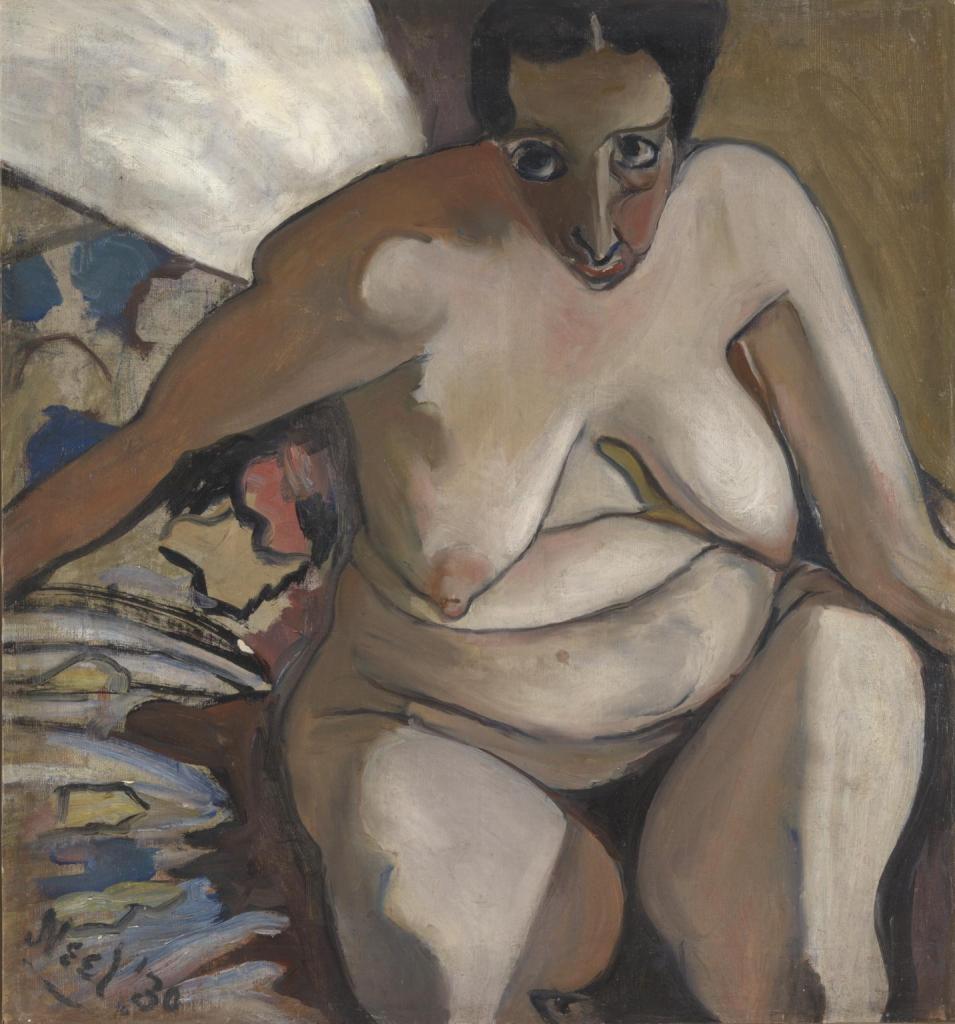
Ethel is sitting down and we’re looking at her from above, like we’re standing in front of her but also towering over her. It’s hard to see what she’s sitting on — some kind of textile, a bedspread or blanket? A patterned couch? There’s the feeling of evening, a close, intimate kind of lighting in the room, all deep shadows and strong highlights, and not much to tell us where we are — an interior space, probably.
But the part that makes me uncomfortable is Ethel’s nudity. Specifically how much of it there is, and how inelegantly it’s presented. She’s not laid out like Manet’s Olympia, delicately posed and yet commanding; she’s not statuesque and perfectly proportioned like Botticelli’s Venus. She’s hunched over, sitting without regard to how she might look from our perspective, how we might see all of her rolls of fat and folded skin. She looks up at us with her large, dark eyes, as though asking us to be kind to her, to be gentle with all of this bare flesh. She’s vulnerable — of course she is. She’s vulnerable because she’s nude and we’re not. (She doesn’t know we’re in a museum, but the point still stands.)
I recognize my own body in hers: the way her abdomen folds twice, three times, as it’s compressed by sitting down; the deep crease in the plump spot where her leg bends at the hip; the way her thighs squish and flatten out around her. I remember the feeling of growing into my body as a teenager, of wearing nothing and looking at it in the mirror in different positions — standing, sitting, bending over, from behind as best I could manage — and feeling something like shame, disgust, a sad resignation. My body looks like this and there is nothing I can do about it. It felt like a personal failure to dislike my own body so much. Actually, it felt more like my own body had failed me. Why did it bulge in these places when I sat down? Why was it so big in the hips and so small in the shoulders? Why didn’t my body reflect my own idealized imagining of what a body — my body — should look like? It should look just like all the other girls’ bodies. I knew I carried my body with a sense of shame, or at least without confidence, and I wanted to be like the other girls, who didn’t even seem to notice they had bodies, who didn’t seem embarrassed at being seen. Then, of course, I got older and realized that someday, someone else would probably see me without my clothes on, and the horror of that was almost too much to think about. I could picture them looking at me, naked, sitting on the edge of a bed, and laughing, or sneering, or recoiling in disgust, and me saying to them, resignedly, I know.
I’m aware now that I’ve been standing in front of this painting for at least five minutes, likely more, and that makes me uncomfortable in a new way. Tony Bennett, citing Foucault, tells us that museums are (at least in part) agents of social control and instruction. There’s a certain way to behave, and a way not to behave — both of which we learn by watching others, whom we know (but probably try to forget) are watching us, too. Aside from the security guards and alarms, it’s what keeps us from touching the art, or from running around and shouting. But now a small, anxious part of my mind has decided that everyone is looking at me looking long and hard at this portrait of a naked woman, and they’re all thinking that I’m probably a pervert obsessed with nudity, and also that I must be gay.
And I am gay, but that isn’t the point. I know this line of thought makes no sense, but it comes from a lifetime of internalized homophobia, a constant fear that people would smell the difference on me and I’d be ostracized for it. At first I didn’t think I was different and so the fear was completely unfounded, but then I realized that the way I felt about girls, while being a girl, probably did make me gay. Suddenly all of those times I’d looked at other girls bodies, wishing that mine looked as small, as neat, as correctly-proportioned as theirs, made me feel leering and predatory. Had I been objectifying them without realizing? That’s what lesbians did, they preyed on unsuspecting straight women — at least according to the girls in the gym locker room.
So in this moment, I’m aware — painfully so — of my whole personal history of looking: looking at myself, looking at others, and fearing that others are looking at my looking. I wonder how Ethel feels about being at the center of this.
Disoriented, I leave the museum for my evening class.
Interlude
The thing I’ve found myself thinking about most since I last saw Ethel isn’t the way she looks, but the quote from Alice Neel that appears below her. It’s the only written information we get about her — the other portraits in the exhibit are of Communist party leaders and feminist activists and other friends of Neel’s, and the wall texts tell us more about who they were. But Ethel is presented with the title — her name — and the following words from Neel:
“Don’t you like her left leg on the right, that straight line? You see, it’s very uncompromising. I can assure you, there was no one in the country doing nudes like this. And also, it’s great for Women’lib [sic] because she’s almost apologizing for living. And look at all that furniture she has to carry all the time.”
That’s all there is about her. And I keep turning the words over and over in my mind, letting them sit and soften around the edges, settle into place. Her uncompromising left leg, so solidly solid, refusing to budge, refusing to be anything but a leg, and a leg of its particular size and shape. When Ethel is so curved and undulating in so many places, this leg is a straight line — an unyielding straight line, an edge — maybe Ethel isn’t so soft and malleable as I’ve been thinking, so pleading. There is in fact a determined structure to her. She is, after all, sitting in front of us, with almost everything of her body exposed. Or maybe the straight line of her leg is there to make the rest of her look even curvier.
But — she’s almost apologizing for living. I recognize that feeling. My body is here and in front of you and for that I am so sorry. I’m sorry you have to look at me, I’m sorry that I look this way, that I couldn’t look better or even just different for you, I’m sorry that I’m taking up this space. Please forgive me. Please don’t hold this against me. I promise this isn’t what I meant to be, I meant to look different, this isn’t what I wanted either. Maybe I’m projecting.
And that bit about the furniture. She has to carry it around all the time. I know that feeling too, of being weighed down, burdened, sometimes by the literal mass of my body but mostly by the knowledge of its presence. Carrying around all these complexes, these thoughts and anxieties and fears. But it’s the furnishing of myself. It’s such a soft and non-judgmental way of thinking about it. It’s not too permanent, either. Maybe I could switch out the couch for a pair of armchairs, or change the upholstery. In any case, it’s a collection of things that are my own, the things among which I live — wide hips and narrow shoulders, a bulge of fat, calloused feet.
The French translation of this quote, the last line, has been circling around in my head too, and it bothers me. « Et regardez toutes ces lourdeurs qu’elle doit porter en permanence. » A body as a kind of permanent heaviness, a burden to carry. Ethel is apologizing for being alive, for being this physical manifestation of a burden. I can’t imagine she would want to feel this way. I want my body to not be a burden.
I think about my body all the time. At some point a few years ago I stopped feeling quite so ashamed of everything about it. Something about male validation assuaged my feelings of inadequacy, for a while at least. And then I realized that I didn’t actually want that, that I didn’t care if I looked acceptable to men, because I didn’t want to be acceptable to them, but also because I didn’t want to look like a woman. I didn’t want to look attractive or unattractive as compared to other women, I didn’t want anyone to look at me and immediately pass judgment one way or the other. I didn’t want to carry this heaviness, this obligation, of being seen all the time. Every day I think about my body, how to make it smaller and bigger, how to make it more and less confusing to everyone, including myself. I guess I’m tired of this furniture.
And who is Ethel apologizing to? To herself, to god, to the patriarchy? Who is this portrait for? The only audience that I know she is aware of, with complete certainty, is Neel. Neel stood before Ethel while she sat like this, saw her as she is here. Ethel must have known someone else would see this portrait, but she couldn’t have known that I would, or that anyone else going to this exhibition would. When she saw this portrait herself, what did she think of it? Did she appreciate the way that Neel saw her? Did she recognize herself, accept herself — despite what she may have thought of her own body — as a work of art?
And what is it that Neel wants us to see, and how does she want us to feel? Pity, admiration, desire, understanding?
Second Encounter
I think one of the most striking things about Ethel is her eyes. It takes a moment to notice them past all the rest of her. I keep thinking, standing in front of her now, that they look so wide and sad. They look like the clear, dopey eyes of a cow. I resist this comparison though. I don’t want to compare her to a cow, even if it’s just the eyes. It’s hard not to meet this gaze that looks up at you – actually, past you. I wonder what the effect would be if you could see the painting from a greater height, or if the painting were hung lower on the wall – if she really looked up at you. Everything about her seems to droop downwards – her face, shoulders, breasts, stomach – except those eyes that look up. This positioning of us above, her below, makes it almost impossible not to feel as though she’s pleading.
You can tell that we’re meant to look at her body first. There’s light coming in from the right side, a spotlight on her body but not on her face. Her face is actually fairly dark, more in shadow, and her nose is such a straight line, almost an arrow, pointing down, leading us to look at the center of her. The light is a little confusing and inconsistent, just barely, and makes it hard to read how her legs are positioned. But it hardly matters what her legs are doing out of the frame. Most of the picture is just the fleshy center of her, we don’t see her lower legs or wrists or hands. Just this lumpy center part.
I like to think she’s on a bed, but I still can’t tell; it comes up behind her, rises to meet her back, in a way that a bed wouldn’t, but the angles aren’t quite right to be a couch – there’s no definite crease separating the seat from the back. Whatever this fabric covered surface is, it’s soft – it squishes beneath her, the creases becoming deeper as they near her right leg and disappear underneath. We can see how heavy she is, how she puts her weight on the seat, how she is sinking down. She’s not trying to look thinner or smaller though. She’s not sucking in her stomach, she’s not tensing any muscles. When you suck in your stomach it makes your shoulders and ribcage rise, ever so slightly, and hers are so small and close to her hips. There’s a power in how relaxed her body is. Her arms are to the side, she lets us see everything.
On second thought, maybe she is trying to hunch down, compact herself. Her shoulders point inwards, her posture is curved. Her right arm braces against the seat and makes her spine torque just a bit. Does she know to feel shame? Does she only feel shame in being looked at this way? How does she feel when she’s naked and alone?
This makes me think again about Neel, this interaction between Neel and Ethel, and between Ethel and whoever she imagined or knew might see this portrait. It’s 1930, and even if it were much later in the century it seems reasonable to imagine that no one would ever see her like this except a lover, or maybe a doctor. Is this look – sad, pleading, curling inwards – a practiced look? Is it at Neel’s request, or is she embarrassed to pose so openly, to be so exposed with the knowledge that this exposure will be recorded?
I know how I feel being looked at and looking at myself and looking at Ethel but I don’t know how she feels about looking, about seeing and being seen. It’s hard not to look at her face, hard not to return to the small darkness of her eyes and nose and soft implication of a mouth, even though all the sharp lines of her eyebrows and cheekbones and chin filter your gaze down to her body, the fleshy piles of fat protecting her inner organs. That’s what matters here, her body. It’s not erotic but it’s not not erotic. She knows she’s being looked at. She’s not hiding but she’s not all out on display. It’s just a slice of her – who else was she?
Interlude
That’s what I’ve been thinking about lately, since seeing her again. She’s enigmatic. We know who other people in the show are – communist party leaders, noted feminists, friends of Neel’s – but Ethel is left without introduction or explanation. I haven’t been ready to try to find out who she is. I like having this private vision of her. It feels like a kind of communion, how I’ve been turning her image over and over in my mind like I’d smooth a stone in my pocket. How my own feelings about bodies are tied up in her body.
I’ve looked up Ethel now, and this painting of her, and how she felt about it, and I feel so tremendously sad that I almost can’t bear it. Ethel Ashton was an artist herself, a part of the New York Ashcan school, and met Neel while they were both students at the Philadelphia School of Design in the early 1920s.2 She began her career by painting nudes, then street scenes and daily life, but eventually moved into abstraction. In a posthumous exhibition of her work, she’s described as modest about her talent, and also a strong personality who knew everyone in the Philadelphia art world.3 But during that period of her life when she knew Neel, she was still finding her way, struggling to become an artist at a time when a woman was supposed to be a wife and a mother.
In 1930, when she painted this portrait, Neel shared a studio with Ethel and another art school friend, Rhoda Myers Medary.4 It was summer, and Neel was on the verge of a breakdown: her first born daughter, just a year old, had died a few years prior, and her husband had just left for Cuba with her second daughter, born in 1928.5 She would soon make an attempt on her life, an act that would send her to a mental institution on and off for a year, but that summer she was having a burst of creative productivity. This was when Neel painted her first female nudes, the genre for which she became best known.6
Neel spoke about her connection to her subjects at varying points in her career, and it’s one of the things critics and scholars consistently reference: Neel had a way of embodying her subject, of “becom[ing] the person for a couple hours,” as she said, which gives her portraits their psychological intensity. She captures the physical form of the body in a realistic, unromantic way, but all that feels secondary to the internal drama she’s able to communicate through facial expressions and body language. It’s the thing that struck me most about every portrait in this exhibition – every person here looks so much like themselves. Even without photographic references, I have the sense that no photographed portrait could do more justice to any one of these faces than Neel’s portraits could.
And so Ethel is a first experiment by Neel in capturing a subject, in capturing their mental and emotional state. This is Ethel, we’re told, as she looked and as she was – who she was. The scholarship describes her as timid, crippled with self-consciousness. But I can’t help but think that maybe Neel’s own experience is at play here. Only another woman, another subject of the patriarchy and its demands of what a woman’s body should look like, could know what it feels like to be seen in such a moment of vulnerability. So much of Ethel’s look is a product of men – the injuries inflicted by the male gaze.7 If this were a portrait of a man, he wouldn’t look nearly as sad, as pleading, as hunched over in shame, and if he did it wouldn’t be believable.
Neel was still figuring out how to confront the female nude at a time when her own body was still young and vulnerable and changing. Maybe Neel felt differently about her post-childbirth body, more confident or accepting or understanding, or maybe she felt a new and different kind of embarrassment at its changes. Ethel’s body was different. More innocent, maybe, still entirely her own, still private.
And now here it is, splashed across the canvas, every perceived flaw and insecurity rendered in unforgiving lines. No one was doing nudes like this, Neel said. Because who would want to be painted this way, with so much vulnerability on display? Who wants their shame to be appropriated and used for someone else’s art? Never mind Neel’s style – the subject here is so raw and hard to look at, even now. It was hard for me to look at, at least.
Ethel hated it. When it was shown at the Philadelphia School of Design’s alumni show in 1973, she saw it and stormed out of the room in a rage.8 She had lived a whole life in those 43 years (she would die two years later), had become an artist, a librarian, had grown and changed.9 And still, confronted by her own body and by the vulnerability that was hers, or maybe Neel’s projection, back then, she was undone. How could you not be? Even a forceful personality, as Ethel was described, has its soft spots. My partner often remarks on how gregarious and lively I am among others – a symptom of being American, I think – but I know that I would have responded the same way as Ethel if I were in her place. All those people looking at your body, looking at its soft vulnerability, thinking about the shame you must have felt, seeing how you were apologizing for being alive. The relationships we have with our bodies are so close and so private and so completely unexplainable – universally complicated and yet entirely unique. Imagine Ethel standing next to her portrait in the flesh, upright and fully clothed, and everyone thinking they know her, or know some part of her.
Here is Ethel, seen through a chink in her armor.
Third Encounter
I’ve come back to see Ethel a final time. It’s a Wednesday afternoon and there’s still a decent crowd, people scattered about the exhibition, but no one in front of Ethel for the moment.
There’s a white line painted on the floor in front of the portrait, with the words “Do not go beyond.” I noticed it before, but now I take a lap around the exhibit to confirm: the portrait of Ethel is the only artwork here with such a barrier. There are blocks, sort of like podiums, at the base of most walls, so the white line feels almost excessive. You couldn’t get close to it in any case, but now there’s a few extra inches of distance mandated. It must be something the Tate, where this portrait normally lives, required, but now I feel that there’s something sad about the metaphorical implication. You can’t get close to this image, but even if you could, I don’t think you could get closer to the heart of it. Could you understand Ethel any more?
In the time since I looked up Ethel and the circumstances in which her portrait was painted, I’ve stopped feeling quite so heartbroken for Ethel. Rather, I still feel bad, but I now am trying to think of it from Neel’s perspective. There’s a quote from Neel, printed in large type on the wall perpendicular to the one Ethel hangs on, that reads: “I have always believed that women should resent and refuse to accept all the gratuitous insults that men impose upon them.” Neel was making a social critique here – look at what society, what the patriarchy, has done to this woman. Look at how she cowers in fear and shame. Neel passes no judgment on bodies – you can tell from this exhibition. In fact, I think she loves bodies, loves how weird and varied and beautiful they are. Her portraits show young and old, people of all races, in the nude, and sometimes in unflattering positions. “It’s great for women’s lib,” she said of the portrait. The portrait is a rallying cry to reject the shame of a female body. I like to think that maybe Neel did it for Ethel, too. Maybe it’s meant to be a kind of totem, holding her insecurities for her, so that she could be free, so that she could see herself – her real self – with new eyes. So she can see and reject how the world has taught her to see herself. Still, though, I wouldn’t have felt much different than Ethel felt about it in the end, being put on display like that, all the world able to see my vulnerability.
I find that I’m no longer embarrassed to look at her so openly and for so long. Still, I want to be polite to other museum-goers, so I give up my spot in front of her and move to stand by a work hanging behind this one. I watch people watch her for a while. They read the words – how she’s apologizing for being alive – look at her, look at her name, sometimes take a picture. Sometimes they just take a picture instead of looking, or look at it through a viewfinder – or, more often, a phone screen. Most of them move on to do the same at the painting that hangs next to her. The tired narrative of the tourist in the art museum, creating a taxonomy of everything they’ve seen, working even when they’re ostensibly on vacation or enjoying leisure time, as Susan Sontag said. People read the title, look at the painting, tilt their head, then – as proof that they’ve done the work of considering it – take a picture.
What is the afterlife of this image? This photograph that almost everyone who stops in front of Ethel takes? What do all of these people think of Ethel, and what will they do with their souvenir pictures? Sit down their friends and family to look at these pictures, show them the strange and exciting art they saw in Paris? Print her out and put her in a scrapbook, or pin her to a cork board? They’ve taken a picture of her name, the title, sometimes, but what are they going to do with that? Look her up, as I have? And then what?
I don’t give these people enough credit, probably. Because isn’t that what I’ve done – taken a picture of this painting, looked it up. And now what?
Maybe it’s just the few minutes that I’m there – maybe it’s just the demographics of the crowd for this exhibition today – but it seems to be mostly women who come to stand before Ethel. Women of all ages. In couples or alone. Some stand before her for a while, reading Neel’s words, laughing, pursing their lips, pointing. Do they see themselves in her, as I did? Will they think of her again?
Everyone, though, likes to take a picture of Neel’s words. They kneel down before Ethel to capture them. They want to capture this understanding of what they’re seeing, maybe. Or maybe it’s just those words – apologizing for living, all that furniture – that resonate.
Today the spotlights that illuminate the paintings are flickering, almost bouncing, so the top edge of the paintings are darker than the rest. It makes the painting of Ethel look almost haunted, mysterious, emerging from a shadowy place. She threatens to recede, to fall back into darkness, and yet still lives on the surface, where we can see her.
Bibliography
Bauer, Denise. “Alice Neel’s Female Nudes.” Woman’s Art Journal 15, no. 2 (1994): 21–26. https://doi.org/10.2307/1358600.
———. “Alice Neel’s Feminist and Leftist Portraits of Women.” Feminist Studies 28, no. 2 (2002): 375–95. https://doi.org/10.2307/3178749.
Woodmere Art Museum. “Ethel V. Ashton.” Accessed December 8, 2022. https://woodmereartmuseum.org/explore-online/collection/artist/ethel-v-ashton.
Footnotes
- Presented by the American Fund for the Tate Gallery, courtesy of Hartley and Richard Neel, the artist’s sons, 2012. http://www.tate.org.uk/art/work/T13703 ↩︎
- “Ethel V. Ashton.” ↩︎
- Ibid. ↩︎
- Ibid. ↩︎
- Bauer, “Alice Neel’s Female Nudes,” 21. ↩︎
- Bauer, 23. ↩︎
- Bauer, “Alice Neel’s Feminist and Leftist Portraits of Women,” 388. ↩︎
- Bauer, “Alice Neel’s Female Nudes,” 23. ↩︎
- “Ethel V. Ashton.” ↩︎
 sarah feustle
Leave a comment